Sunday, July 18, 2010

Veau Viennoise, Leeks Vinaigrette

Mmhm. Two huge back to back work projects plus a complete hard drive crash spells B-U-R-N-O-U-T. I decided to take a break from cooking and blogging for a bit just to maintain sanity. Now I'm back and it's time to play catch-up!

One of the last things I cooked before taking hiatus was Veau Viennoise--that is, fried Veal scallopine. This is the first real veal dish that I've made from this cookbook, since I'm honestly not too keen on veal. It's not a very nice process to make veal (and this is from the girl who happily laps up foie gras at every opportunity), and even if I weren't bothered by that, I just don't find the taste that great. But I decided to give this dish a try when I found some free-range veal at the farmer's market, for a limited time this spring.

Ok I know you are scratching your head at the oxymoronic term "free-range veal," but here's the thing, the veal is made by never locking the calves up, but keeping them with their mother before they are slaughtered. Which is not PETA approved, naturally, but a little better than the pro-chainy variety of veal. So, I decided to give this dish a shot.

Here's a shot of the veal. It actually looks pretty good, doesn't it?


I started out by making the garnishes for the veal. Some nice fat lemon slices, chopped up hard boiled egg, and anchovies rolled around single caper berries. This was a pretty promising start.

Next, I made some bread crumbs by toasting some bread slices, and whizzing them through the food processor. (Pretty easy and way better than those horrible blue cans!)

Then I set up the veal assembly line: beaten eggs, seasoned flour, and bread crumbs.


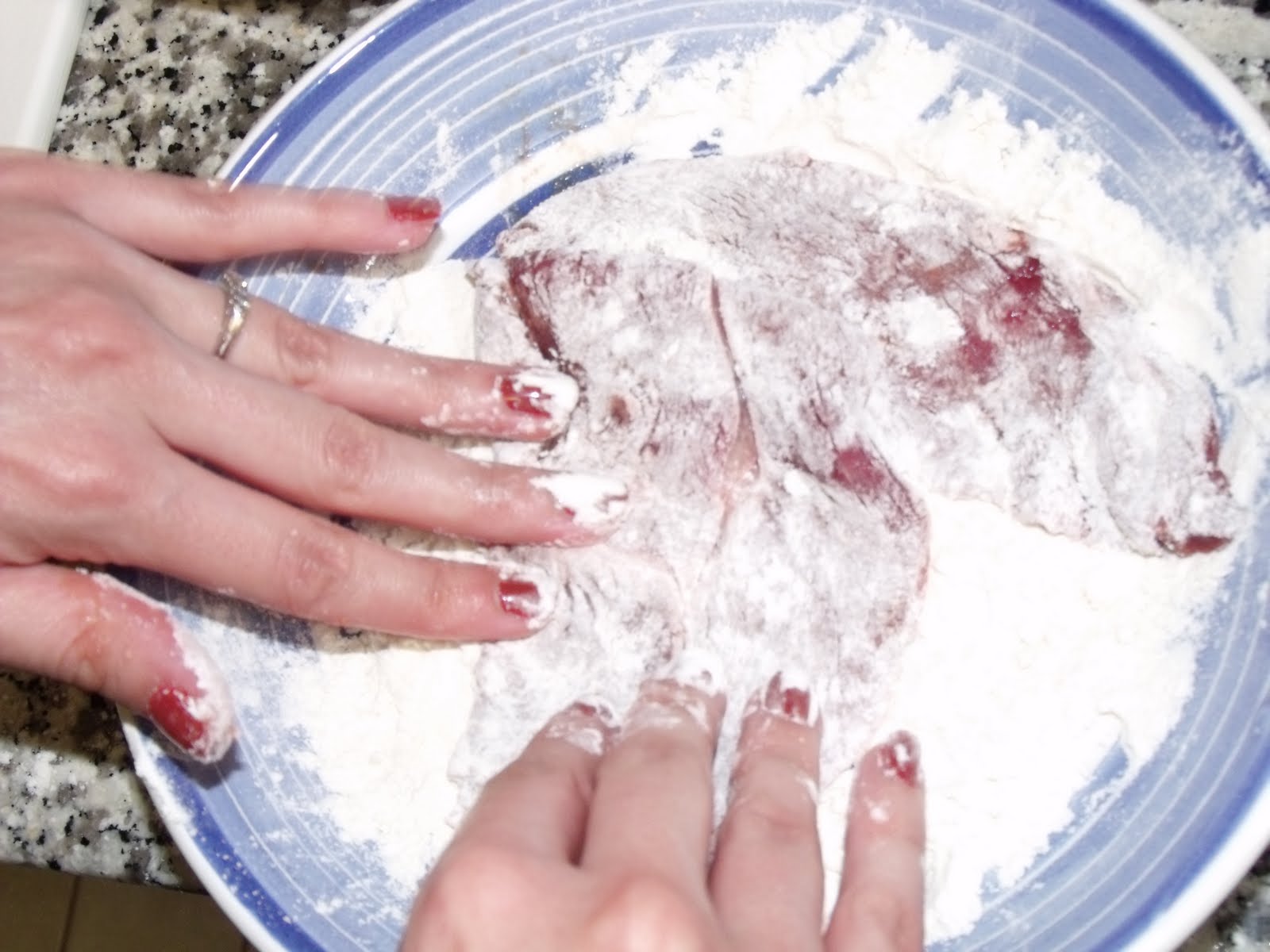
It is pretty easy to see what to do here. First dredge the meat in the flour, then the egg, then the bread crumbs until they are nicely coated. The meat gets refrigerated for a few hours.


While the meat chilled I made a side dish--leeks vinaigrette with sauce gribiche.

First I sliced the leeks in half so that they could soak, removing the grit from their layers.


Then I made sauce gribiche, which consists of chopped hard boiled egg, cornichons, capers, and parsley mixed with peanut oil and vinegar.


The leeks get boiled for about ten minutes until they are tender, then dressed with the sauce gribiche.

Finally, it is time to fry up some veal! I heated peanut oil in my sauté pan, then fried the scaloppine until the crumbs were golden brown.


Once the veal was all fried, I served them topped with lemon slices, caper and anchovies, and alongside chopped onion and hard boiled egg, with leek vinaigrette.


Also, champagne.


Looks good, but how did it taste? Well, it was okay. The veal itself was not bad, and I enjoyed it with far less guilt than non free range veal. But to be honest, the whole breaded and deep fried meat thing is not my favorite thing to eat, even though this was a good specimen of the species. I did like the mixed pickle/egg flavor of the sauce gribiche on the leeks, and would definitely make that again. All in all, not a bad dinner, but not my favorite.

However, one of the benefits of this dish was that I realized that deep frying is not so scary after all. Check out what I was able to make:


Yup, I am a fearless deep fryer, and made Thomas Keller's fab fried chicken for a Fourth of July picnic! Next up... frites!

Lessons Learned: Free range veal does exist! Deep frying is not so scary, and can be fun and rewarding.

Next Week: Well... Husband J is on a trip next weekend, so I'm cooking for one. I think I'll make a favorite thing that I DON'T want to share. That would be escargots, the world's greatest excuse to eat pretty much melted butter for dinner. Whoo!

Sunday, June 6, 2010

Chartreuse of Quail

So, who here is sick and tired of me whussing out on this project with soup? Yeah, me too. So I decided that this weekend, I would need to step up my game and make something truly fancy. I was musing over this one morning, thinking of what I could make while flipping through the book, and then turned to the page for Chartreuse of Quail. This multi-step dish involves a truly stunning layered presentation, and specialty ingredients. It would be perfect... if I could pull it off.

First thing is to get the specialty ingredients. Chartreuse of Quail calls for... quail, duh, but also foie gras. These are both pretty hard to find under normal circumstances, even in a big city with a Whole Foods every couple of miles. Foie gras in particular is pretty hard to come by locally, considering Whole Foods has stopped selling lobster for humanitarian reasons. However, there is always the magic of MAIL ORDER MEATS! Yep, there are companies that will overnight foie gras, or whatever interesting and exotic cut of meat you'd care to order. I went with D'Artagnan, which is a venerable company, and much discussed in food blogging circles. D'Artangan sells four-packs of whole quail, and 5-ounce packs of foie gras for what I consider a very reasonable price. I ordered the packs to be delivered overnight for a Friday morning delivery, the day when Husband J takes advantage of his government-mandated flex time. He me the Fed-Ex guy at the door, and our ingredients were safe in the fridge.


Okay, hurdle one accomplished. Next, time to debone the quail. Chartreuse of quail calls for the breasts of the quail to be separated from the rest of the body, and the legs reserved as a garnish for the dish. This is fine when you have a chicken, but with a quail, it's easy to cut straight through the fragile bones and leave sharp points that could cut an unwary eater. I used a paring knife to cut down the sides of each quail's spine, and separated the bones from the rest of the carcass as follows:


Tiny quail bodies.


Cutting the breasts away...

This left me with eight breast slices, and eight legs. I seasoned the breasts with salt and pepper and sauteed them, skin side down, for five minutes.


Then I took the breasts, which were only partially cooked, and set them aside.


I also sauteed the quail legs for use as a garnish.


Next, it was time to prepare the cabbage. I peeled big leaves off of a head of cabbage, and boiled them for five minutes in salted water. I set the leaves aside.


And then I made stuffing by sauteeing some chopped bacon with carrot and onion until the vegetables were browned.


To this mix, I added shredded cabbage and sauteed it all until it was soft, shiny and wilted--about half an hour.

Finally, I made a rich buttery sauce. I deglazed the quail pan with some port wine.


I set that aside, and roasted the quail carcasses with some butter, carrot and onion in a big pan.


Once the veggies and carcasses were roasted, I deglazed the pan with more port.


Then I transferred all of it to a saucepan. I added some herbs and pepper, and some chicken stock, and simmered the lot until it was reduced by half.


I strained the liquid out into another saucepan, and boiled the sauce for 15 minutes.
Finally, I whisked a good sized knob of butter into the pot for a rich sauce.


Ok, all of the elements of the dish have been made. Now for the hard part... molding the chartreuses. Yes, you heard me right... this dish involves molding all of the ingredients into a layered terrine.

First, I buttered some ramekins, and laid a cabbage leaf into each one, letting the sides of the leaf flop over the sides. Next, I scooped some bacon-cabbage stuffing into each mold.


Then, I layered some foie gras, and two quail breasts over the stuffing.


More stuffing went on top of the breasts, then folded the cabbage leaf over the stuffing. Finally, I topped each mold with a round of bread that had been brushed with melted butter.


I chucked the carefully constructed molds into the oven to bake for about a half an hour. Then, with trepidation, I put on my oven mitt and upturned the first mold onto a plate, and...


OMG IT SO WORKED!!!

Wanna see that again from the side? Oh yes you do.


Awwwww yeah.


When we cut the molds open, a delicious mix of quail meat, foie gras, bacon and veggies greeted us.

According to Husband J, this was one of the best things I'd ever cooked, and that it rivals his prior favorite, the Coquilles St. Jaques. I think the coquilles were better, myself, but I thoroughly enjoyed the delicious quail molds. They were tasty. They were impressive. And best of all, these were super EASY to do. Sure, it took a bit of effort and expense to get the ingredients, and time to assemble the things, but overall, there was not much difficulty in putting these together. And they make such a spectacular product. I'd say that this dish wins the prize for "the dish you want to make to impress someone into thinking you are more talented than you actually are. And by the way, DELICIOUS."

Lessons Learned: Just because the dish looks crazy fancy doesn't mean it's difficult to make. Mail order meats are a viable and not too expensive source of specialty ingredients. Foie gras is crazy delicious.

Next Week: Veau Viennoise

Sunday, May 23, 2010

Tomato and Fennel Soup

Phew. Another hard work week gone by (by the time this posts, a couple of weeks), filled with labor, late nights, and eating at the same restaurant every day of the week with co-workers... the glory of business travel. Funny how those things work. At the start of the week I was thrilled for oxtails and scallops with wine-butter sauce, but by the end of the week I was practically crying for salads and lightly cooked veggies, with maybe a ravioli or two. And because the weekly schedule was work, dinner, work, get to hotel at ass-o-clock AM, try to sleep and fail because of strange hotel room, up, work... by the time I wrapped my lips around a glass of wine, I was about ready to compose florid verse in praises of the grape. Yeah, that atmosphere did not conduct itself to a desire to cook once I dragged myself home. I made a halfhearted attempt at celery remoulade, but was thwarted by the lack of celeriac (I swear I saw it at the market last week... or was it two weeks ago? Guess that will have to wait for autumn, now). I collapsed in exhaustion, and woke up wanting something simple, nutritious, and above all, EASY. So I chose this tomato and fennel soup.

Now, don't get me wrong kids, it is still May, and there aren't any worthwhile tomatoes out yet. But here's the awesome thing, tomato and fennel soup from the Les Halles Cookbook uses tomatoes in a CAN! I used to be mighty skeptical about any food that comes in a can, because in my experience canning tends to turn veggies into a slimy, preserved mess. Just think of all that canned spinach and canned beet you were subjected to as a child! Fresh roasted beet is like an orgasm compared to canned beet, amirite? But recently I have come to love canned tomatoes. This is partly because of a determination to never, ever buy out-of-season fresh tomatoes that I made a few years ago, but mostly because they are just really good for making soups and sauces. They retain their flavor nicely, and the slimy texture disappears once they are cooked down, pureed, or otherwise assembled.

Also, in non-conformance with the rest of my project, I ended up making this soup on a weeknight. Yes, you heard me. It is that easy.

First, I cored two fennel bulbs by cutting them into quarters and removing the core. I sliced them on my mandoline until I had a stack of slices.


A lovely fennel root.

Next, I chopped an onion and a potato.


The potato, onion, and chopped fennel.

I heated some olive oil in my big pot, then added the veggies and cooked them for about ten minutes.


Next, the tomatoes went into the pot to cook.


Finally I added 6 cups of chicken stock and cooked the whole mess for an hour.


Once the soup was cooked, I blended it all with a hand blender, and added salt and pepper.


To serve, I added salt and pepper, and squirted some balsalmic glaze that I had left over from a French Laundry Cookbookexperiment in a Jackson-Pollocky design I served the soup alongside some grilled cheese.


The color is kind of odd, isn't it? Instead of the murky, red color of canned tomato soup, this is more of a milky orange. But let me tell you, this soup is incredibly delicious. It's creamy with no dairy (yay, potato), and thick to stand up to dipping a grilled cheese sandwich into the bowl. The balsamic glaze is no mean feat either!

Lessons Learned: Making tomato soup from scratch is easy, delicious and satisfying. And it can be done on a weeknight!

Next Week: Something fancy: Chartreuse of Quail.

Sunday, May 9, 2010

Steak au Poivre and Asparagus & No Haricots Verts Salad

Like I wrote in my Easter post, I just went through a pretty long stretch of not having time to cook much, or write, which meant a kind of involuntary hiatus from the Les Halles Cookbook project. This is not too happy, as I have really enjoyed making these dishes, and I still have a ways to go, considering I'm not exactly holding myself to a rigorous schedule. So, last week I declared a hiatus to my hiatus, and pretty much spent the weekend cooking various things, including this steak au poivre.

After proposing a Les Halles dinner to Husband J, I asked him if there was anything he particularly wanted, and he requested steak. Since the red wine butter steak requires a grill or grill pan (though I may just make it on my cast iron skillet anyway so as not to purchase cluttery pans), I decided on steak au poivre, one of my favorite types of steak. This sounded like it needed a fresh spring salad, so I decided on the asparagus and haricots verts salad, since I figured it was high time to find those particular veggies fresh at the market. However, I must have been too late or too early, because there was not a haricot vert to be had, alas. I decided to make the salad anyway, with fresh spring greens instead of haricots verts.

With steak au poivre, the most important thing is, of course, cracked peppercorns. I measured out 2 ounces of peppercorns on my handy scale:


Now to crack them. Which was a problem, because suddenly I realized that outside of a grinder, I had no idea how to crack peppercorns. The magic that is google told me that one thing to do is put the peppercorns into a zip-loc and crack them with a rolling pin. Husband J offered me a hammer, which I snobbishly declined, wielding my rolling pin. But there was another problem, I didn't have a ziplock. I had the bright idea of wrapping the peppercorns in some saran-wrap. Once wrapped, I gave them a good whack with my rolling pin. And... the saran-wrap promptly split, spilling many of the corns onto my kitchen floor. Great. After sweeping the floor, I tried again with more loosely wrapped peppers. This did not lead to floor spillage, but didn't do much in the pepper cracking department. For a little while I found success cracking one peppercorn at a time, but as you can see above, that process would probably take me into the next decade. In the end, I swallowed my pride and took Husband J's hammer, which worked much better, particularly considering the peppercorns were denting the edge of the wooden rolling pin a little.


Cracked peppercorns and the implements of their destruction.

With the peppercorns cracked, I started on the asparagus. The asparagus needs to get blanched for the salad, so I started up a big pot of salted water. Once the water boiled, the asparagus went in for about 5 minutes, and then into an ice bath to stop the cooking process. Easy!


Asparagus in its ice water bath.

By the way, notice how the asparagus in this photo is neatly wrapped and not all over the place like, say, all my bouquet garnis ever? Well after almost a year of searching, I have finally found kitchen twine. Hooray!

After measuring out the mise for the steak sauce, I took the steak out of the fridge and cut it into four portions.


Next, I brushed the steaks with olive oil, and dredged them in the cracked peppercorns. They went into a pan of olive oil and butter to saute.


After getting browned on both sides, the steaks go into the oven for a few minutes, during which time I made the steak sauce. I stirred cognac into the oil/butter mix in the pan, and then reduced the liquid by half. Next I stirred some veal stock and demi-glace into the pan, and then reduced it some more. Finally, I whisked half a stick of butter into the pan to make a thick, creamy, cognac-y sauce laced with extra peppercorns.


To make the salad vinaigrette, I stirred some olive oil and lemon juice together, and then seasoned it with salt and white pepper--again, super easy. Finally, I tossed the asparagus, greens, and orange slices with the vinaigrette.

And the final product:


This was amazing. The steak was very delicious and tender, and the peppercorns added the perfect bite. The cognac sauce was absolutely brilliant and saturated fatty, and we ended up tearing bits of baguette, soaking them in the sauce, and eating them. The salad was also wonderful, and Husband J was boggled that it was only lemon juice and olive oil with a little seasoning. Of course, it helped that the veggies were perfectly fresh and in season, so thanks farmers at the market.

Husband J said that this dish was definitely one of the top ones that I've made, which made me very happy. It's nice to have something go perfectly, after the too-big-lamb debacle, and undercooked-pork horror.

Lessons Learned: Crack the peppercorns with a hammer--don't ruin your rolling pin. Fresh spring veggies taste amazing with just a little seasoning.

Next week: Thinking of something with veal...

Sunday, May 2, 2010

Rôti de Porc au Lait and Parsnip Puree

Phew, I don't know about you all, but it is really hot this evening, and has been all day. Not much to do but hang around the apartment drinking water and laying under the ceiling fan, or if you are me, cooking with full burners and the oven on. Yep, I'm crazy. But I figure it will take a couple of very delicious dinners to convince Husband J to start fanning me with palm fronds and spritzing me with Evian all day.

Few weeks back I made a dish much more suited to the cooler weather--rôti de porc au lait (pork roasted in milk) with parsnip puree. If you'll all turn your hymnals to page 173, you'll see a very mouthwatering picture of a golden pork roast being basted in creamy milk. The reality of this dish is not exactly how that picture makes it look, but it is tasty.

First things first, obtaining a pork loin roast. Obviously the only place I can ever go for pork is my trusty vendor, Cedarbrook Farm. At their stall I learned the difference between a European pork loin roast (bone in, skin on) and an American pork loin roast (skinless, boneless, but with a very nice layer of fat lining one side). Since the recipe calls for boneless, I went with the American roast. I carted this home, and put it in the fridge, and then into the sink in an ice bath, to thaw.

To cook the roast, first brown it on all sides in a large pot.


Pork bubbling away in a mix of olive oil and butter.

While searing the pork, I chopped up the veggies used to create the milk sauce: carrot, leek, onion and garlic.


Mise en place for the veggies. The upper right bowl contains garlic confit, which I threw into the parsnip puree on a whim.

After the roast had been seared, I set it aside, and added the chopped veggies to the pot to caramelize over high heat.


Next, I added flour and the milk, and a bouquet garni.


This whole mess gets brought to a boil, then the pork is added, and the pot turned down to a simmer. Then the lid goes on the pot to cook for 1 hour.


So far, so good. While the pork cooked, I made the parsnip puree. This is insultingly easy--just chop the parsnips, boil until soft, strain, and pulse in a food processor while adding some salt, white pepper, and a full stick of butter. (Yesss.) I also added some garlic confit, as I said earlier, for a little kick.

After the hour, I removed the pork from the pot, and set it aside to rest. I decided to skip straining the sauce, and instead pureed the entire mess, veg and all, with my stick blender, until it formed a creamy orange sauce.

Then I cut into the pork, and was met with this:


Oh good lord... the pork didn't cook more than half an inch into the roast! At this point our dinner guest had already arrived, and I started panicking. I shoved the entire thing into the oven for a half an hour, and was met with still rawish pork coming out of the oven. In a despair spurred by not desiring to make people sick and get sued, I decided to cut the pork up and saute the slices until they were done. This seemed to work, so I slathered the sauce onto the meat and served.


Not the prettiest shot of dinner ever, but hey, nobody died.

The pork was very succulent, the sauce was delish, but the real star of the dinner was the butter--I mean parsnip--puree. I haven't eaten many parsnips in my time but this has made me a convert, as they are sweet, creamy and delicious.

I was a little sad that the sauce was not the white, creamy, milky sauce featured in the photograph, but other bloggers who have made the dish before me have also come out with a rather chunky orange sauce instead, so I figure I must be doing that bit right.

It took me a while to think of why the pork just did not cook at all according to the recipe, but I think it's because the massive chunk of meat just didn't defrost properly in the time I gave it. Next time I guess it's straight into the ice bath as soon as it's brought home, rather than into the fridge first.

Lessons learned: Do a better job at defrosting. Parsnips are freaking fantastic, especially with a stick of butter mixed in them.

Next week: Steak au Poivre.